Forward Looking Statements
Except for statements of historical fact, certain information contained herein constitutes forward-looking statements. Forward looking statements are usually identified by our use of certain terminology, including “will”, “believes”, “may”, “expects”, “should”, “seeks”, “anticipates”, “has potential to”, or “intends’ or by discussions of strategy, forward looking numbers or intentions. Such forward-looking statements involve known and unknown risks, uncertainties and other factors which may cause our actual results or achievements to be materially different from any future results or achievements expressed or implied by such forward-looking statements. Forward-looking statements are statements that are not historical facts, and include but are not limited to, estimates and their underlying assumptions; statements regarding plans, objectives and expectations with respect to the effectiveness of the Company’s business model; future operations, products and services; the impact of regulatory initiatives on the Company’s operations; the size of and opportunities related to the market for the Company’s products; general industry and macroeconomic growth rates; expectations related to possible joint and/or strategic ventures and statements regarding future performance. Junior Gold Report does not take responsibility for accuracy of forward looking statements and advises the reader to perform own due diligence on forward looking numbers or statements.
Gold prices could be setting up to surge big-time. Investors should be closely watching the yellow precious metal, as there are a few developments that could provide a rosy outlook for gold prices in 2016 and beyond.
You see, in 2013, one of the biggest reasons gold prices tumbled—and investors panicked—was the big investment houses turning pessimistic toward the yellow metal. They thought interest rates would go up and central banks would implement tighter monetary policies.
For instance, Goldman Sachs Group Inc(NYSE:GS) called gold a “slam dunk” sell and forecasted that the gold price would hit around $1,000 an ounce.
After the call from Goldman Sachs, several other investment houses came out with similar calls regarding gold prices. We even saw calls for gold prices dropping to around $800.00.
Here’s what you have to know: investors usually pay attention to these calls and act on them.
When Goldman Sachs and others financial institutions were saying gold will drop, investors ran for the door. Now, about three years later, we are seeing the complete opposite.
Those banks that were bearish on gold prices then are now turning bullish. With this, you have to ask one question: are investors going to follow their calls as well and run to buy gold?
Not too long ago in May, Goldman Sachs raised its forecast for gold prices and its rhetoric toward the precious metal changed significantly.
Bank of America Corp (NYSE:BAC) said, “We reinforce our bullish view particularly on gold and silver, which should continue to perform well given subdued global growth and risks that this will skew the public debate towards wealth generation/distribution, populism and migration, with all the negative consequences this may have on effective economic policy making.” (Source: “Gold Going To $1,500, Silver To $30, Says BoAML,” Kitco News, July 8, 2016.) The investment house said gold prices could shoot up to $1,500 an ounce.
HSBC Holdings plc (ADR) (NYSE:HSBC) also upped its gold price forecast. It expects the precious metal to hit $1,400 an ounce.
HSBC said, “We continue to expect some of these factors, notably continued accommodative Fed policies and investor demand, to support gold and add another reason for strength in the months ahead: increased demand for perceived ‘safe-haven’ assets following the U.K.’s vote to leave the EU (European Union).” (Source: “HSBC Ups Gold Forecast But Sees Potential Ceiling At $1,400/Oz,”Kitco News, July 5, 2016.)
Gold Prices Outlook for 2016
Dear reader, the list of banks turning bullish toward gold prices is getting longer by the day. We have heard positive calls from Morgan Stanley (NYSE:MS), UBS Group AG (USA) (NYSE:UBS), andCommerzbank as well.
When something like this is happening, you have to follow the gold market very closely. I truly believe this could have positive consequences for gold prices for the rest of 2016 and beyond.
With all this said, I keep my stance and believe gold mining shares are where investors will find the biggest rewards. If we assume gold prices will jump just 20%–30% from where they currently trade (I believe $2,000 gold prices is very possible in the next few years), there are several gold mining companies that could see explosive gains.
Forward Looking Statements
Except for statements of historical fact, certain information contained herein constitutes forward-looking statements. Forward looking statements are usually identified by our use of certain terminology, including “will”, “believes”, “may”, “expects”, “should”, “seeks”, “anticipates”, “has potential to”, or “intends’ or by discussions of strategy, forward looking numbers or intentions. Such forward-looking statements involve known and unknown risks, uncertainties and other factors which may cause our actual results or achievements to be materially different from any future results or achievements expressed or implied by such forward-looking statements. Forward-looking statements are statements that are not historical facts, and include but are not limited to, estimates and their underlying assumptions; statements regarding plans, objectives and expectations with respect to the effectiveness of the Company’s business model; future operations, products and services; the impact of regulatory initiatives on the Company’s operations; the size of and opportunities related to the market for the Company’s products; general industry and macroeconomic growth rates; expectations related to possible joint and/or strategic ventures and statements regarding future performance. Junior Gold Report does not take responsibility for accuracy of forward looking statements and advises the reader to perform own due diligence on forward looking numbers or statements.
Gold’s 2016 bull run has finally become the consensus call for analysts, pundits and forecasters…
‘BLACK SWAN’ has become a very over-used phrase, even amid 2016’s relentless shocks and surprises, writes Adrian Ash at BullionVault in this note first sent to Weekly Updatereaders last Monday.
Maybe ‘grey goose’ would be better. Or simply Daffy Duck…just to describe this year’s manic intensity.
Either way, 2016 has brought a slew of events few people imagined, and fewer still thought possible…let alone likely…and certainly not all at once.
As one wag says, if you have a friend now waking up after a year in a coma, start with Leicester winning the English football Premier League atodds of 5000-to-1, and work up slowly from there.
Then ready yourself for more low-chance yet inevitable shocks ahead.
Marketing hype is nothing new, in other words. But a live black swan became a very real novelty in 1697, when Dutch explorers found a river full of the birds as they navigated into Australia.
Things you can barely imagine, in short, do happen. The issue to deal with is how the shock will affect you.
Amid all the politics, slaughter, upsets and rage in 2016, perhaps the least shocking black swan for investors so far has been the turnaround in gold and silver prices.
But spurred by the US Federal Reserve’s apparently stunning failure to raise interest rates from the 0.50% it finally reached last December however, this sudden bull market in precious metals certainly caught the entire finance industry off guard, including most specialist bullion analysts.
Gold would fall below $1000 by March, said last year’s best forecaster, Bernand Dahdah at French bank Natixis as the New Year began.
Instead, he now says it could reach a high of $1750 per ounce sometime next year.
Gold would end 2016 at $900 reckoned Dutch bank ABN Amro in January.
US bank Citigroup’s chief economist Willem Buiter famously called gold nothing but a “6,000-year old bubble”. But now he thinks gold “looks pretty good”…
…because we now live “in times of uncertainty and especially in days of uncertainty laced with negative [interest] rates.”
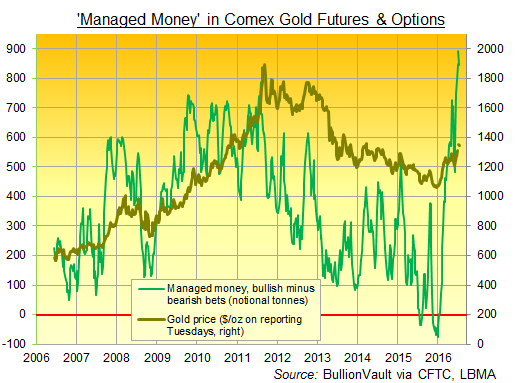
And as for money managers and hedge funds…they were betting against gold prices rising as 2016 began.
Such bullishness should make existing owners a bit nervous, as long-term gold and silver investors won’t need reminding.
Gold peaked on the morning of 6 July…losing 3.5% for US and Euro investors since then, and dumping almost 7% for UK investors…just as everyone agreed that this bull market is so rock-solid, it cannot be “jinxed”.
But the back-half of 2016 sees gold and silver starting from a very different place from New Year. Panics and surprises like Turkey’s attempted coup will now be expected to send gold prices soaring…causing lots of hmm’ing and haw’ing if they don’t.
Disappointment is highly likely for precious metals’ newly bullish bears. That should give longer-term investors running their own money…and managing their own risk…a chance to build their holdings as the backlash begins amongst disappointed headline writers and embarrassed analysts.
Inflation, meantime, remains a fantastical beast which central banks, money managers, governments and the vast majority of savers just cannot imagine.
If this year’s black swans are to turn truly financial, watch the sky for a fast-rising cost of living.
Adrian Ash runs the research desk at BullionVault, the physical gold and silver market for private investors online. Formerly head of editorial at London’s top publisher of private-investment advice, he was City correspondent for The Daily Reckoning from 2003 to 2008, and is now a regular contributor to many leading analysis sites including Forbes and a regular guest on BBC national and international radio and television news. Adrian’s views on the gold markethave been sought by the Financial Times and Economist magazine in London; CNBC, Bloomberg and TheStreet.com in New York; Germany’s Der Stern and FT Deutschland; Italy’s Il Sole 24 Ore, and many other respected finance publications.
Please Note: All articles published here are to inform your thinking, not lead it. Only you can decide the best place for your money, and any decision you make will put your money at risk. Information or data included here may have already been overtaken by events – and must be verified elsewhere – should you choose to act on it. Please review our Terms & Conditions for accessing Gold News, RSS links are shown there.
Junior Gold Report’ Newsletter: Junior Gold Report’s Newsletter is published as a copyright publication of Junior Gold Report (JGR). No Guarantee as to Content:Although JGR attempts to research thoroughly and present information based on sources we believe to be reliable, there are no guarantees as to the accuracy or completeness of the information contained herein. Any statements expressed are subject to change without notice. JGR, its associates, authors, and affiliates are not responsible for errors or omissions. Consideration for Services: JGR, it’s editor, affiliates, associates, partners, family members, or contractors may have an interest or position in featured, written-up companies, as well as sponsored companies which compensate JGR. JGR has been paid by the company written up. Thus, multiple conflicts of interests exist. Therefore, information provided herewithin should not be construed as a financial analysis but rather as an advertisement. The author’s views and opinions regarding the companies featured in reports are his own views and are based on information that he has researched independently and has received, which the author assumes to be reliable. No Offer to Sell Securities: JGR is not a registered investment advisor. JGR is intended for informational, educational and research purposes only. It is not to be considered as investment advice. Subscribers are encouraged to conduct their own research and due diligence, and consult with their own independent financial and tax advisors with respect to any investment opportunity. No statement or expression of any opinions contained in this report constitutes an offer to buy or sell the shares of the companies mentioned herein. Links: JGR may contain links to related websites for stock quotes, charts, etc. JGR is not responsible for the content of or the privacy practices of these sites. Release of Liability: By reading JGR, you agree to hold Junior Gold Report its associates, sponsors, affiliates, and partners harmless and to completely release them from any and all liabilities due to any and all losses, damages, or injuries (financial or otherwise) that may be incurred.
Forward Looking Statements
Except for statements of historical fact, certain information contained herein constitutes forward-looking statements. Forward looking statements are usually identified by our use of certain terminology, including “will”, “believes”, “may”, “expects”, “should”, “seeks”, “anticipates”, “has potential to”, or “intends’ or by discussions of strategy, forward looking numbers or intentions. Such forward-looking statements involve known and unknown risks, uncertainties and other factors which may cause our actual results or achievements to be materially different from any future results or achievements expressed or implied by such forward-looking statements. Forward-looking statements are statements that are not historical facts, and include but are not limited to, estimates and their underlying assumptions; statements regarding plans, objectives and expectations with respect to the effectiveness of the Company’s business model; future operations, products and services; the impact of regulatory initiatives on the Company’s operations; the size of and opportunities related to the market for the Company’s products; general industry and macroeconomic growth rates; expectations related to possible joint and/or strategic ventures and statements regarding future performance. Junior Gold Report does not take responsibility for accuracy of forward looking statements and advises the reader to perform own due diligence on forward looking numbers or statements.
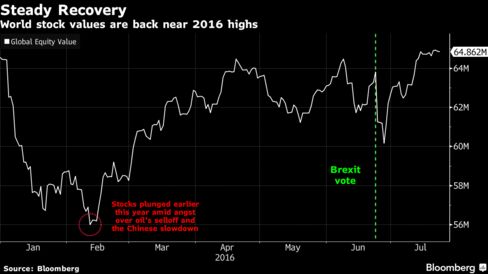
U.S. stocks fell from records as crude slid below $44 a barrel amid a surplus, while gold fell as the dollar gained before central bank meetings in the U.S. and Japan this week.
The S&P 500 Index retreated with energy shares pacing declines among nine of 10 main groups in the gauge. Equity markets in Europe got a boost from a report showing Germany’s business climate remained robust after Britain voted to secede. Gold extended its first back-to-back weekly drop since May as the U.S. currency gained against most of its 16 counterparts. Turkish markets rallied the most worldwide after the prime minister said the government will set up a fund to support the economy following the failed coup.
Global equities were little changed before key central-bank policy meetings and as investors await a slew of corporate results. U.S. equities advanced to a fresh record Friday amid signs of strength in the American economy that prompted traders to increase bets the Federal Reserve will raise rates by year-end. While the Fed will probably keep rates on hold this week, economists predict the Bank of Japan will add to stimulus. The European Central Bank last week said it would be ready, willing and able to act if needed.
“Earnings are the key this week, but there’s also the Fed, the Bank of Japan and the Democratic National Convention, so you have a lot of things that go right or wrong,” said John Canally, chief economic strategist at LPL Financial, which oversees about $479 billion in Boston. “We’ve run the market up to new all-time highs at peak valuations, so we have to hit a home run on earnings to get much higher from here.”
Stocks
The Stoxx 600 climbed 0.3 percent by 9:45 a.m. in New York, with trading volumes 45 percent less than the 30-day average. Ryanair Holdings Plc rose 6 percent after maintaining its annual profit forecast. Ericsson AB advanced 2.3 percent after its chief executive officer stepped down. Julius Baer Group Ltd. increased 4.4 percent after adding new client money.
The S&P 500 Index lost 0.2 percent. Yahoo! Inc. agreed to sell its main web businesses to Verizon Communications Inc. for $4.8 billion. Yahoo fell 0.8 percent after the announcement and Verizon slipped 0.4 percent.
The Borsa Istanbul 100 Index added 3.3 percent after Prime Minister Binali Yildirim ruled out early elections and said Turkey plans a multi-billion dollar infrastructure fund to keep growth on track. The stock measure sank 13 percent last week, the most since 2008, amid sweeping purges of those accused of complicity in the failed attempt July 15 by military officers to seize power.
In Asia, Nintendo Co. shares plunged by the most since 1990 after the company said late Friday that the financial benefits from the worldwide hit Pokemon Go will be limited. The stock sank 18 percent to 23,220 yen at the close in Tokyo, the maximum one-day move allowed by the exchange, wiping out 708 billion yen ($6.7 billion) in market value.
Currencies
The dollar advanced against 13 of its 16 peers, climbing at least 0.7 percent against Mexico’s peso and Canada’s dollar. The Bloomberg Dollar Spot Index added 0.2 percent, headed for the highest close since March.
Turkey’s lira climbed 1.1 percent, the most among 31 major currencies.
Singapore’s dollar fell 0.2 percent to the lowest in almost a month. The city-state’s central bank, which uses the exchange rate rather than interest rates as its main tool,said the current monetary policy stance is appropriate as it forecast inflation may turn positive later this year. The Malaysian ringgit weakened for a sixth straight day, losing 0.2 percent.
Commodities
West Texas Intermediate crude slipped 2.1 percent to $43.28 a barrel after sliding 1.3 percent on Friday to its lowest settlement since May 9. Rigs targeting oil in the U.S. rose for a fourth week to 371, the longest run of gains since August, according to Baker Hughes Inc. Money managers also added the most bets in a year on falling WTI prices during the week ended July 19, according to Commodity Futures Trading Commission figures.
“The general tone for the market at the moment is soft to sideways,” Ric Spooner, chief analyst at CMC Markets in Sydney, said by phone. “It’s being weighed down by U.S. dollar strength against a background of relatively high inventories and the fact the rig count has begun to creep up.”
Precious metals declined, with gold extending the first back-to-back weekly drop since May, falling 0.6 percent to $1,314.26 an ounce as buoyant equity markets and expectations for higher U.S. interest rates hurt demand. Silver retreated 0.9 percent, while palladium declined 1.1 percent.
Bonds
Treasuries maturing in a decade were little changed at 1.57 percent before an auction of $26 billion of two-year notes, the first of $103 billion of planned offerings of coupon-bearing securities this week.
U.K. gilts declined for the first time in three days, pushing the two-year yield up by two basis points to 0.14 percent, while that on 10-year securities were at 0.82 percent, an increase of three basis points from the close on Friday.
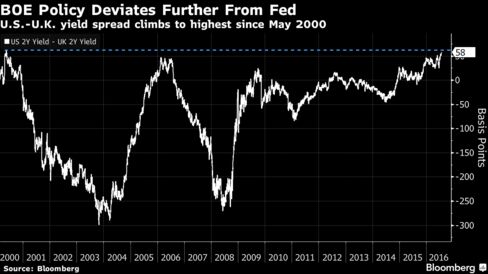
A month after voters opted for Brexit, U.K. bonds are yielding the least in 16 years relative to their U.S. counterparts, reflecting speculation that the Bank of England will loosen policy to mitigate the economic impact of the vote. The extra yield, or spread, that investors get for holding U.S. two-year notes instead of similar-maturity gilts was at 58 basis points, the most since May 2000, based on closing Bloomberg generic prices.
The cost of insuring corporate debt against default declined for the third time in four days. The Markit iTraxx Europe Index of credit-default swaps on investment-grade companies dropped one basis point to 67 basis points. An index of swaps on junk-rated businesses declined two basis points to 316 basis points.
Junior Gold Report’ Newsletter: Junior Gold Report’s Newsletter is published as a copyright publication of Junior Gold Report (JGR). No Guarantee as to Content:Although JGR attempts to research thoroughly and present information based on sources we believe to be reliable, there are no guarantees as to the accuracy or completeness of the information contained herein. Any statements expressed are subject to change without notice. JGR, its associates, authors, and affiliates are not responsible for errors or omissions. Consideration for Services: JGR, it’s editor, affiliates, associates, partners, family members, or contractors may have an interest or position in featured, written-up companies, as well as sponsored companies which compensate JGR. JGR has been paid by the company written up. Thus, multiple conflicts of interests exist. Therefore, information provided herewithin should not be construed as a financial analysis but rather as an advertisement. The author’s views and opinions regarding the companies featured in reports are his own views and are based on information that he has researched independently and has received, which the author assumes to be reliable. No Offer to Sell Securities: JGR is not a registered investment advisor. JGR is intended for informational, educational and research purposes only. It is not to be considered as investment advice. Subscribers are encouraged to conduct their own research and due diligence, and consult with their own independent financial and tax advisors with respect to any investment opportunity. No statement or expression of any opinions contained in this report constitutes an offer to buy or sell the shares of the companies mentioned herein. Links: JGR may contain links to related websites for stock quotes, charts, etc. JGR is not responsible for the content of or the privacy practices of these sites. Release of Liability: By reading JGR, you agree to hold Junior Gold Report its associates, sponsors, affiliates, and partners harmless and to completely release them from any and all liabilities due to any and all losses, damages, or injuries (financial or otherwise) that may be incurred.
Forward Looking Statements
Except for statements of historical fact, certain information contained herein constitutes forward-looking statements. Forward looking statements are usually identified by our use of certain terminology, including “will”, “believes”, “may”, “expects”, “should”, “seeks”, “anticipates”, “has potential to”, or “intends’ or by discussions of strategy, forward looking numbers or intentions. Such forward-looking statements involve known and unknown risks, uncertainties and other factors which may cause our actual results or achievements to be materially different from any future results or achievements expressed or implied by such forward-looking statements. Forward-looking statements are statements that are not historical facts, and include but are not limited to, estimates and their underlying assumptions; statements regarding plans, objectives and expectations with respect to the effectiveness of the Company’s business model; future operations, products and services; the impact of regulatory initiatives on the Company’s operations; the size of and opportunities related to the market for the Company’s products; general industry and macroeconomic growth rates; expectations related to possible joint and/or strategic ventures and statements regarding future performance. Junior Gold Report does not take responsibility for accuracy of forward looking statements and advises the reader to perform own due diligence on forward looking numbers or statements.
As we’ve been following for the past two weeks, the USDJPY has now rallied seven points or 7% in just eight days as Krazy Kuroda in Japan has promised to buy 1T yen worth of new government debt and perhaps even begin the “helicopter money” plan of direct government debt monetization going forward.
The correlation between the yen and gold has been present for years and we have monitored it closely since 2014. As a reminder, here’s how it looks in 2016:
This unexpected rally in the USDJPY (the inverse of the yen shown above) has conveniently helped the market-making Bullion Banks to manage their positions into the front-and-delivery month August gold expirations next week. Here’s the calendar:
Tuesday, July 26– August gold option expiration
Thursday, July 28 – August gold contract “expiration” as it goes “off the board”
Friday, July 29 – August gold First Notice Day as August gold trades only with 100% margin and in its “delivery” phase
Previously in 2016, there’s a clear pattern of price management and selloffs as front-and-delivery month contracts moved toward expiration. As you can see below, the latter stages of March (ahead of April) and May (ahead of June) saw declines similar to what are seeing now:
But more importantly, look at the gold price action while “deliveries” were taking place this year. During the calendar months of February, April and June, gold has soared anywhere from 7% to 12%! Could August be setting up for a similar move? Yes!
And what, besides the end of the August expirations next week could prompt such a turnaround? Most likely, another change in sentiment and trend in the USDJPY. And what might cause that shift? Two events that will occur within 36 hours of each other next Wednesday and Friday:
Wednesday, July 27 – FOMC meeting ends with “Fedlines” announced at 2:00 pm EDT. No rate changes!
Friday, July 29 – The Bank of Japan meets and releases its latest QE plans. However, with the USDJPY already having moved over 7% ahead of this “news”, this sets up as a classic “buy-the-rumor, sell-the-news” event. The thought here is that the USDJPY then will resume its downtrend in early August. See link here: http://www.reuters.com/article/us-boj-markets-idUSKCN10032J
And the USDJPY has already reached a major point of resistance on its chart. This, too, hints at a turnaround soon and continuation of the downtrend:
So, if we’re looking at a reversal and continuation of gold’s 2016 uptrend in August, how far might the next leg up take price. For an answer, we’re going to consult another chart.
Back in February, we started following an important breakout on gold’s weekly chart. The chart below is from Friday, March 7 and shows goldfinally breaking out from its nearly 3-year downtrend:
What happened next? Well, as noted above, March was an “expiration” month for the April Comex contract AND, even more importantly, a breakout of this 3-year trend was something that The Banks wanted to avoid. By the end of the month, the chart looked like this:
Eventually, though, the falling USDJPY and the surging amount of global debt with negative interest rates served to drive gold even higher. By the middle of June, it became clear that The Banks were going to lose this fight. The Brexit vote that followed only served to seal their fate:
The last remaining line of defense for The Banks and their maintenance of a downtrend in gold was violated with the weekly close back on Friday, July 8. (Again, what an interesting coincidence that Kuroda’s unexpected announcements came before trading resumed the following Monday, July 11.) Here’s a chart we posted with that day’s podcast review:
As you can see, it should have been clear to any objective observer that gold had bottomed and a renewed bull market had begun. That The Banks have used the USDJPY strength and the Spec liquidation surrounding August contract expirations to their advantage should, therefore, come as no surprise. They are attempting the same block-and-stall routine that they put on gold back in March when it broke out of its 3-year down channel. Therefore, expect the same fight now. Though we should expect price improvement and a renewed rally in August, do not be surprised if it takes until October for gold to really get cooking to new highs. Again, the March to May action around the earlier breakout is your guide.
So, summing up, what should we expect going forward:
Further choppy to downward price action into late next week. It’s still possible that gold could trade as low as $1285 and back near its 50-day moving average before bottoming. This area has proven as support all year
.
A renewed rally in August back to near, but likely not exceeding much, the highs of late June and early July. Something between $1370 and $1390. Talk will begin to spread that gold has seen a “double top”.
Another tumble in mid-late September as the next front and delivery month (October) comes off the board, However, October is never a big volume or big “delivery” month. Instead, most of the action after August typically shifts into the December contract. Therefore, following the 2016 pattern, any dropoff in September should be more shallow than what we’re seeing at present.
Then, finally, a breakout to new 2016 highs in October and November. This year-end rally should take gold all the way back to near the April 2013 manipulated breakdown level of $1525. Let’s call it $1475-$1525.
So there you go. That’s what we expect. If I’m proven correct, I’ll gladly take all the adulation that comes this way. If we’re wrong…well, I’m not eating my hat again. That almost killed me last time.
Junior Gold Report’ Newsletter: Junior Gold Report’s Newsletter is published as a copyright publication of Junior Gold Report (JGR). No Guarantee as to Content:Although JGR attempts to research thoroughly and present information based on sources we believe to be reliable, there are no guarantees as to the accuracy or completeness of the information contained herein. Any statements expressed are subject to change without notice. JGR, its associates, authors, and affiliates are not responsible for errors or omissions. Consideration for Services: JGR, it’s editor, affiliates, associates, partners, family members, or contractors may have an interest or position in featured, written-up companies, as well as sponsored companies which compensate JGR. JGR has been paid by the company written up. Thus, multiple conflicts of interests exist. Therefore, information provided herewithin should not be construed as a financial analysis but rather as an advertisement. The author’s views and opinions regarding the companies featured in reports are his own views and are based on information that he has researched independently and has received, which the author assumes to be reliable. No Offer to Sell Securities: JGR is not a registered investment advisor. JGR is intended for informational, educational and research purposes only. It is not to be considered as investment advice. Subscribers are encouraged to conduct their own research and due diligence, and consult with their own independent financial and tax advisors with respect to any investment opportunity. No statement or expression of any opinions contained in this report constitutes an offer to buy or sell the shares of the companies mentioned herein. Links: JGR may contain links to related websites for stock quotes, charts, etc. JGR is not responsible for the content of or the privacy practices of these sites. Release of Liability: By reading JGR, you agree to hold Junior Gold Report its associates, sponsors, affiliates, and partners harmless and to completely release them from any and all liabilities due to any and all losses, damages, or injuries (financial or otherwise) that may be incurred.
Forward Looking Statements
Except for statements of historical fact, certain information contained herein constitutes forward-looking statements. Forward looking statements are usually identified by our use of certain terminology, including “will”, “believes”, “may”, “expects”, “should”, “seeks”, “anticipates”, “has potential to”, or “intends’ or by discussions of strategy, forward looking numbers or intentions. Such forward-looking statements involve known and unknown risks, uncertainties and other factors which may cause our actual results or achievements to be materially different from any future results or achievements expressed or implied by such forward-looking statements. Forward-looking statements are statements that are not historical facts, and include but are not limited to, estimates and their underlying assumptions; statements regarding plans, objectives and expectations with respect to the effectiveness of the Company’s business model; future operations, products and services; the impact of regulatory initiatives on the Company’s operations; the size of and opportunities related to the market for the Company’s products; general industry and macroeconomic growth rates; expectations related to possible joint and/or strategic ventures and statements regarding future performance. Junior Gold Report does not take responsibility for accuracy of forward looking statements and advises the reader to perform own due diligence on forward looking numbers or statements.
When times are tough, new economic theories get a better hearing. Maybe some old ones, too.
The gold standard is one of the oldest ideas about money, but the hardest of hard-money hawks sense an opening to breathe new life into it. Decades ago, the amount of cash circulating in a country was often limited by the stash of bullion held in its coffers. Especially since 2008, developed-world policy has headed in the exact opposite direction, expanding the powers of central banks to stoke growth. Helicopter drops of money, potentially the next new thing, would be a giant leap further.
For those in the U.S. who see much risk and little benefit in the current course, gold is still a rallying point. And their audience may be growing.
“The fringe has become the mainstream,” said Jesse Hurwitz, a U.S. economist at Barclays Capital in New York. He sees the gold standard as a bad idea but “something we’ll increasingly talk about.”
Of course, full restoration of the system that reigned in the U.S. for a century through the 1970s is almost inconceivable. Even many gold bugs say it can’t be done, and there’s near-unanimity among economists that it shouldn’t be attempted: the U.S. would be in much worse shape, they say, with a Federal Reserve stripped of its ability to freely tinker with the money supply.
But the backdrop to this well-rehearsed debate is changing. Rumbling discontent with the economy has left the establishment under siege, and you can’t get more establishment than the Fed. So, in a curious twist, it’s becoming easier for supporters of hard money — historically a policy favored by the rich — to give the idea a populist slant. The money conjured up by central bankers after the crisis, the argument goes, all went to bankers, leaving most Americans no better off. It’s time to tie the Fed’s hands, if not to gold, then at least to something.
“We don’t need to be a slave to history,” said George Selgin, director of the Center for Monetary and Financial Alternatives at the Cato Institute in Washington. The gold standard is “like Humpty Dumpty,” he said, hard to put back together. But “we can think about having a monetary system that isn’t completely arbitrary, where it isn’t just a matter of discretion, people sitting in a room 13 times a year doing whatever.”
‘Hijacked by Bankers’
For a while, to the hard-money folks, the U.S. election season must have appeared full of promise.
The Fed was getting bashed from all sides. “It is unacceptable that the Federal Reserve has been hijacked by the very bankers it is in charge of regulating,” Democratic candidate Bernie Sanders said in a New York speech in January. Economists who support Sanders, like Nobel prizewinner Joe Stiglitz, see the Fed’s quantitative easing as a form of trickle-down economics that’s exacerbated inequality.
The proponents of gold or some other fixed monetary rule are more likely to be found in the Republican Party, and what they object to is the very idea of money creation by fiat, not just its distributional effect. Still, there’s some overlap.
Ted Cruz, in one of the early candidate debates last year, said the Fed “should get out of the business of trying to juice our economy and simply be focused on sound money and monetary stability, ideally tied to gold.”
‘Solid Country’
Then there was Donald Trump. “We used to have a very, very solid country because it was based on a gold standard,” he told WMUR television in New Hampshire in March last year. But he said it would be tough to bring it back because “we don’t have the gold. Other places have the gold.”
In more recent interviews, the presumptive nominee sounds like he’s drifted toward asoft-money worldview. Last week, he drew attention to the U.S. government’s ability to print money. To the gold bugs, that’s a problem — but Trump painted it as a potential solution.
Below the presidential level, though, the gold camp and its allies have gained support.
“There’s a growing constituency within the House Republican membership that a more rules-based approach or a gold standard would be advantageous,” said Hurwitz of Barclays.
‘It Was Horrific’
Not all Republicans welcome the development.
The gold standard “was awful. It was horrific,” said Tony Fratto, a former Treasury and White House official in the George W. Bush administration. “It led to some of the worst economic downturns and bouts of deflation in history.”
Fratto, now a managing partner at Hamilton Place Strategies LLC, a Washington-based consulting firm for financial companies, says monetary policy is “the least well-understood” of economic disciplines — and that makes the central bank an easy target.
Those targeting it include the “Audit the Fed” movement led by Kentucky Senator Rand Paul, whose father Ron Paul has been a standard-bearer for gold. Trump and Sanders are among those who’ve endorsed the effort to scrutinize the central bank’s books.
Playing Games
For other critics, the goal is to impose new rules on the Fed. What would they look like? Cato’s Selgin favors the ideas of a school known as market monetarists, who say the money supply should be adjusted according to a target for overall spending in the economy.
Another, better-known option is the Taylor Rule, which dictates interest-rate adjustments based on changes to inflation and output. The formula has fans in Congress. It’s surfaced in some of the multiple bills aimed at overhauling the Fed — none of which have yet reached the floor of the House.
Bill Huizenga, a Michigan Republican and chairman of the House Financial Services subcommittee on monetary policy, sponsored one of them. He sees talk of a new gold standard as “more of an academic exercise than a real-world exercise,” but supports rules that would restrain the “games being played” by central banks worldwide.
George Gilder thinks gold-standard ideas are on the way back whatever the politicians do. Founder and chairman of the Gilder Technology Group and a bestselling author who helped popularize supply-side economics in the Reagan era, he says the trillions of dollars that fly around global currency markets every day are a “bizarre abuse of capitalism,” sucking vitality out of the real economy.
Apocalypse Soon?
Gilder sees hope in countries like China that are “oriented toward a gold valuation” — the Chinese are unfairly maligned for manipulating their currency, he says, when what they wanted was to do the opposite and fix its value — and in the rise of bitcoin, a digital version of gold.
Running through a lot of the gold talk is an apocalyptic strain. True believers think a crash is coming that will blow away the current consensus, leaving only their ideas standing.
Gilder sees a political backlash when negative interest rates start taking away people’s savings. Jim Rickards, chief global strategist at money manager West Shore Funds and author of “The New Case for Gold,” says the Fed and its peers have expanded their balance sheets to “the outer limit of confidence.”
Rickards helped negotiate the rescue of Long-Term Capital Management in the late 1990s and says it’s been downhill ever since. “In 1998, Wall Street bailed out a hedge fund. In 2008 the Fed bailed out Wall Street,” he said. “What’s going to happen in 2018? It’s going to be the IMF bailing out the central banks.”
He sees a chance of “close to 100 percent” that a downturn worse than the Great Recession is on the way in the next few years — and then, “you’re going to be hearing a lot more about gold.”
Junior Gold Report’ Newsletter: Junior Gold Report’s Newsletter is published as a copyright publication of Junior Gold Report (JGR). No Guarantee as to Content:Although JGR attempts to research thoroughly and present information based on sources we believe to be reliable, there are no guarantees as to the accuracy or completeness of the information contained herein. Any statements expressed are subject to change without notice. JGR, its associates, authors, and affiliates are not responsible for errors or omissions. Consideration for Services: JGR, it’s editor, affiliates, associates, partners, family members, or contractors may have an interest or position in featured, written-up companies, as well as sponsored companies which compensate JGR. JGR has been paid by the company written up. Thus, multiple conflicts of interests exist. Therefore, information provided herewithin should not be construed as a financial analysis but rather as an advertisement. The author’s views and opinions regarding the companies featured in reports are his own views and are based on information that he has researched independently and has received, which the author assumes to be reliable. No Offer to Sell Securities: JGR is not a registered investment advisor. JGR is intended for informational, educational and research purposes only. It is not to be considered as investment advice. Subscribers are encouraged to conduct their own research and due diligence, and consult with their own independent financial and tax advisors with respect to any investment opportunity. No statement or expression of any opinions contained in this report constitutes an offer to buy or sell the shares of the companies mentioned herein. Links: JGR may contain links to related websites for stock quotes, charts, etc. JGR is not responsible for the content of or the privacy practices of these sites. Release of Liability: By reading JGR, you agree to hold Junior Gold Report its associates, sponsors, affiliates, and partners harmless and to completely release them from any and all liabilities due to any and all losses, damages, or injuries (financial or otherwise) that may be incurred.
Forward Looking Statements
Except for statements of historical fact, certain information contained herein constitutes forward-looking statements. Forward looking statements are usually identified by our use of certain terminology, including “will”, “believes”, “may”, “expects”, “should”, “seeks”, “anticipates”, “has potential to”, or “intends’ or by discussions of strategy, forward looking numbers or intentions. Such forward-looking statements involve known and unknown risks, uncertainties and other factors which may cause our actual results or achievements to be materially different from any future results or achievements expressed or implied by such forward-looking statements. Forward-looking statements are statements that are not historical facts, and include but are not limited to, estimates and their underlying assumptions; statements regarding plans, objectives and expectations with respect to the effectiveness of the Company’s business model; future operations, products and services; the impact of regulatory initiatives on the Company’s operations; the size of and opportunities related to the market for the Company’s products; general industry and macroeconomic growth rates; expectations related to possible joint and/or strategic ventures and statements regarding future performance. Junior Gold Report does not take responsibility for accuracy of forward looking statements and advises the reader to perform own due diligence on forward looking numbers or statements.